How Much Damage To Write Off A Car in Australia? Key Factors Explained
A car accident can leave you wondering whether your vehicle is worth repairing or whether the damage is serious enough for an insurer to declare it a write-off. The answer depends on more than visible damage.
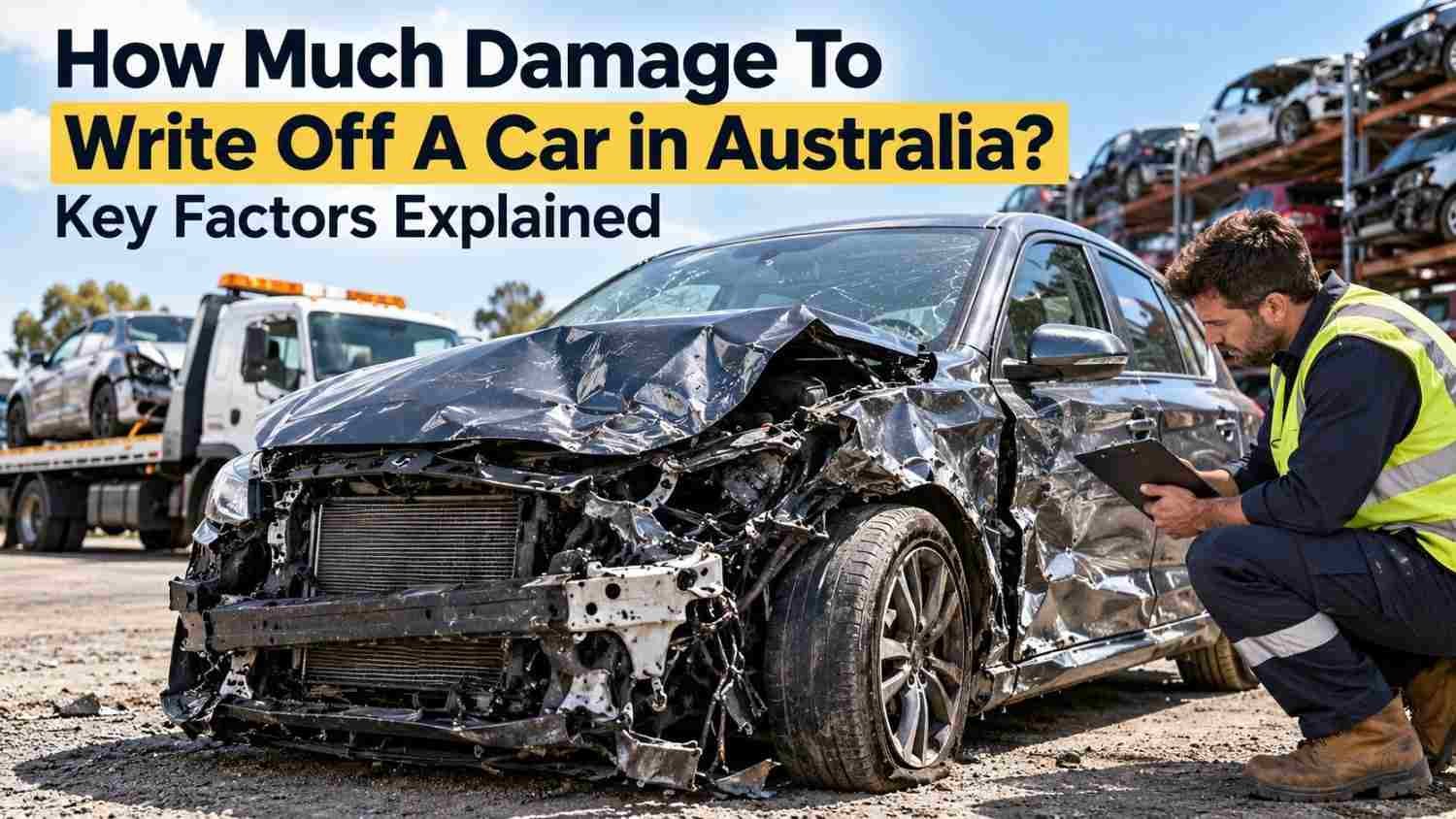
A car accident can leave you wondering whether your vehicle is worth repairing or whether the damage is serious enough for an insurer to declare it a write-off. The answer depends on more than the visible damage. Repair costs, the car’s market value, structural safety and the applicable state or territory rules can all influence the outcome.
Understanding how write-off decisions work can help you make informed choices after an accident. In this guide, we explain how insurers assess damaged vehicles, what different write-off classifications mean, and what you can do if repairing your car is no longer a practical option.
Quick Answer: How Much Damage Does It Take to Write Off a Car?
There is no single percentage of damage that automatically makes every car a write-off in Australia. An insurer may declare a vehicle a total loss when the cost of repairs and the vehicle’s salvage value make repairing it uneconomical. A vehicle can also be classified as a statutory write-off if its damage meets specific safety-related criteria.
The decision depends on the vehicle, the extent and type of damage, repair estimates, market value and relevant state or territory requirements. If your car has been badly damaged, a professional assessment is the best way to understand its condition and available options.
How Much Damage Does It Take to Write Off a Car in Australia?
A car can be written off when it is unsafe to repair under the applicable statutory criteria or when the financial case for repairing it no longer makes sense. There is no universal rule stating that damage must reach 50%, 70% or another fixed percentage of the car’s value before it can be written off.
For example, a relatively new vehicle with substantial structural damage may be assessed differently from an older vehicle with similar damage. An older car might be declared a total loss even when the damage appears less severe because the estimated repair bill is high compared with its market value.
When people search for how much damage to write off a car australia, they are often looking for a simple dollar amount or percentage. In practice, the decision requires an assessment of the vehicle and the relevant circumstances.
It is also important to distinguish between an insurer declaring a vehicle a total loss and the vehicle receiving a particular write-off classification. A total-loss assessment considers the financial and safety aspects of the damage, while the applicable statutory criteria determine whether the vehicle can legally be repaired and potentially returned to the road.
How Do Insurers Decide Whether a Car Is a Write-Off?
Insurers generally arrange an assessment to establish the extent of the damage, the likely repair cost and the vehicle’s value before the accident. The assessor may inspect visible damage, investigate affected components and obtain estimates from repairers.
The assessment commonly considers:
- Pre-accident market value: What the vehicle was worth immediately before the incident, according to the relevant valuation method and policy.
- Estimated repair costs: The cost of parts, labour, paintwork, mechanical repairs and other necessary work.
- Salvage value: The amount the damaged vehicle may be worth in its current condition.
- Safety considerations: Whether the damage affects important structural or safety systems.
- Applicable write-off rules: Whether the damage meets statutory write-off criteria in the relevant jurisdiction.
For example, imagine an older vehicle with a pre-accident market value of $6,000 and a repair estimate of $5,500. Depending on the salvage value, policy terms and assessment method, the insurer may decide that repairing it is uneconomical.
These figures are illustrative only. Insurers do not all use one universal repair-cost percentage, and a particular example cannot predict the result of an individual claim.
Key Factors That Affect a Car Write-Off Decision
Several factors can influence whether a damaged vehicle is economical and safe to repair. Looking at the damage alone rarely provides the complete picture.
Repair Costs Compared With the Car's Market Value
The relationship between repair costs and the vehicle’s pre-accident value is one of the major financial considerations.
A repair bill that represents a relatively small portion of a newer car’s value may be reasonable. The same bill could make an older, lower-value vehicle uneconomical to repair.
Assessors may also consider the vehicle’s salvage value and the terms of the insurance policy. As a result, two vehicles with similar damage can receive different outcomes.
This is why there is no fixed percentage that applies to every accident. The decision depends on the overall assessment rather than one number in isolation.
Structural and Safety-Related Damage
Damage to the chassis, frame, suspension mounting points or other important structural areas can raise serious safety concerns. Modern vehicles also contain safety systems that may require specialist inspection and replacement after a collision.
Airbag deployment, damage to seatbelt pretensioners and compromised crumple zones can add complexity to repairs. Even if the exterior panels look repairable, the underlying structure may need extensive work.
Where damage meets the applicable statutory write-off criteria, the vehicle may be classified as a statutory write-off. This classification is different from a vehicle that is considered a total loss primarily because of repair costs.
Safety should always take priority over appearance or the potential cost of repairs.
Vehicle Age, Condition and Depreciation
A vehicle’s age and condition can influence its market value, which in turn affects the financial assessment.
An older car may have a lower resale value, even if it was well maintained before the accident. If replacement parts are expensive or difficult to source, repair costs can quickly approach or exceed its value.
Assessors may also consider the vehicle’s pre-accident condition, model, kilometres travelled and other relevant valuation factors.
For owners, this can be frustrating. A car may have been reliable for years, but that does not necessarily mean a major repair will be financially worthwhile after a collision.
Hidden Damage After an Accident
Not all accident damage is visible from the outside. A vehicle that appears to have a damaged bumper or a few dented panels may also have damage behind the bodywork.
Potential hidden problems include:
- Bent structural components or damaged mounting points.
- Cooling system damage, including the radiator and associated components.
- Suspension or steering damage.
- Electrical faults and damaged wiring.
- Airbag and other restraint-system faults.
- Damage to sensors and driver-assistance systems.
A proper inspection can reveal problems that are not obvious in photographs or during a quick visual check. These findings may change the estimated repair cost and the overall assessment.
If your car has been involved in a collision, avoid assuming it is safe to drive simply because the damage looks minor.
What Is the Difference Between a Repairable and Statutory Write-Off?
The terms repairable write-off and statutory write-off describe different classifications. The precise rules and consequences depend on the state or territory where the vehicle is recorded and registered.
| Classification | What it generally means |
|---|---|
| Repairable write-off | The vehicle has been assessed as a total loss but has not sustained damage that automatically makes it ineligible for repair under the relevant statutory criteria. Whether it can be repaired and registered depends on local requirements. |
| Statutory write-off | The vehicle has sustained damage that meets specified statutory criteria. It is generally not eligible to be repaired and returned to road use, although it may still have value for parts or scrap. |
A repairable write-off is not automatically an easy or inexpensive repair. The vehicle may need extensive work, inspections, certification and compliance with registration requirements before it can legally return to the road.
A statutory write-off, on the other hand, cannot generally be restored for normal road use. It may still be sold for permitted purposes, such as parts or scrap, subject to the applicable rules.
Can a Car Be Written Off Even If the Damage Looks Minor?
Yes. A vehicle can be declared a total loss even when the visible damage appears relatively minor.
Consider a car with a damaged front bumper. The bumper may be inexpensive to replace, but an inspection could reveal damage to the cooling system, sensors, headlights or other components behind it. The additional work may significantly increase the repair estimate.
Similarly, damage to safety-critical components can have implications beyond the cost of replacing a panel. The vehicle’s age, market value and applicable write-off criteria also matter.
The reverse can be true as well. A vehicle with extensive cosmetic damage is not automatically a statutory write-off. The assessment must establish the type and extent of damage and apply the relevant rules.
If the car looks repairable, arrange a proper inspection before deciding whether to proceed with repairs or sell it.
Does Flood or Hail Damage Affect a Car Write-Off Decision?
Yes. Flood and hail damage can affect a write-off assessment, but the outcome depends on the extent of the damage and the applicable criteria.
Flood-damaged cars
Floodwater can affect electrical systems, control modules, sensors, upholstery, mechanical components and other parts of a vehicle. Saltwater exposure can be particularly concerning because of corrosion and damage to electrical connections.
Some problems may not appear immediately. A vehicle may start and run after a flood but develop electrical or mechanical faults later.
If your car has been exposed to floodwater, do not assume it is safe simply because it still operates. Arrange a suitable inspection and avoid starting a vehicle if doing so could create a safety risk.
Hail-damaged cars
Hail can leave dents across the bonnet, roof, boot and other body panels. The damage may be mainly cosmetic, but extensive panel damage, paintwork and repair requirements can make the job expensive.
For a vehicle with a relatively low market value, even widespread hail damage can lead to an uneconomical repair decision.
Hail damage is not automatically a statutory write-off. The assessment depends on the damage, the vehicle and the relevant rules. NSW also has specific arrangements for certain vehicles written off solely because of hail, so owners should confirm how those rules apply to their circumstances.
What Happens After Your Car Is Declared a Write-Off in Australia?
The next steps depend on your insurance policy, the type of write-off and your state or territory’s requirements. If an insurer declares your vehicle a total loss, it should explain the assessment and the proposed claim settlement.
The process may involve the following steps:
- Review the assessment: Ask for an explanation of the damage, estimated repair costs and valuation used.
- Understand the settlement: Check whether the policy provides an agreed value or market value and review any applicable excess, exclusions or deductions.
- Confirm the classification: Establish whether the vehicle is recorded as a statutory write-off or falls under another relevant category.
- Check registration requirements: Registration cancellation and restrictions depend on the applicable jurisdiction and vehicle classification.
- Decide what happens to the vehicle: Depending on the insurer’s settlement and the rules, the vehicle may be retained by the insurer or dealt with through an authorised salvage or recycling process.
If you disagree with the insurer’s valuation or decision, ask for the reasons and supporting information. You can review your policy documents and follow the insurer’s internal complaints process if you believe the decision is incorrect.
Do not assume that accepting an insurance settlement automatically gives you the right to keep the damaged vehicle. Ownership and salvage arrangements depend on the settlement terms and circumstances.
Can You Keep or Sell a Written-Off Car in NSW?
A written-off vehicle may still have value, but what you can do with it depends on its classification and the NSW rules.
The NSW Government explains that written-off light vehicles generally cannot be re-registered, except in limited circumstances. Vehicles recorded as written off may still be bought and sold for permitted purposes, such as parts or scrap metal. Certain hail-damaged vehicles and other specific cases are subject to separate arrangements.
Before selling or retaining a damaged vehicle, consider these steps:
- Confirm the vehicle’s status: Check the applicable written-off vehicle records and registration requirements.
- Understand any insurer conditions: If an insurance claim is involved, confirm who owns the salvage vehicle after settlement.
- Be clear about the vehicle’s condition: Provide accurate information about known damage and its status.
- Choose an appropriate buyer: A damaged vehicle may be suitable for a buyer or recycler that handles vehicles in that condition.
- Keep relevant paperwork: Retain ownership documents and any records needed to complete the transaction lawfully.
If you are unsure about the vehicle’s legal status, consult NSW Government guidance on owning or buying a written-off light vehicle before making arrangements.
What Should You Do If Your Car Is Too Expensive to Repair?
If the repair estimate is close to or higher than your vehicle’s value, it is worth comparing the available options before committing to expensive work.
Obtain a clear repair estimate
Ask a qualified repairer to explain the necessary work, the expected costs and any uncertainties. Where appropriate, ask whether further inspection is needed to identify hidden damage.
Review the insurer’s decision
If you have insurance, check how the vehicle was valued and how the settlement was calculated. Ask questions if the assessment or proposed outcome is unclear.
Compare repair costs with replacement options
Consider the likely total cost of repairing the car, including any additional work that may be required, against the cost of replacing it with a suitable vehicle. Also consider whether the repaired vehicle will meet your needs.
Explore selling the damaged vehicle
If repairing the car is not financially practical, selling it may be another option. The potential value depends on its make, model, age, condition, damage and legal classification.
For owners in Sydney, Damaged Car Removal is one option to explore when a vehicle is no longer practical to repair. Atlantic Car Removals can discuss the details of your damaged car and the available arrangements. Any offer and collection arrangements will depend on the vehicle and its circumstances.
Before agreeing to a sale, confirm the buyer’s terms, the vehicle’s permitted use, any ownership requirements and what documentation is needed.
Avoid making a decision based on appearance alone
A badly dented vehicle may still have usable components, while a car with modest visible damage may have expensive underlying problems. A proper assessment and a clear understanding of the vehicle’s status can help you make a more informed decision.
Frequently Asked Questions
Is there a fixed percentage of damage that makes a car a write-off?
No. There is no single percentage that applies to every vehicle across Australia. The assessment may consider repair costs, pre-accident market value, salvage value, safety and the applicable statutory criteria.
Does the cost of repairs determine whether a car is written off?
Repair costs are an important factor in an insurer's total-loss assessment, but they are not the only consideration. The vehicle's value, salvage value, policy terms and safety-related damage may also affect the outcome.
Can an older car be written off after a minor accident?
Yes. If the vehicle has a relatively low market value, even a modest-looking accident may result in repair costs that are uneconomical. An inspection may also uncover hidden damage that increases the estimated cost.
Can a repairable write-off be registered again in NSW?
Not automatically. NSW has restrictions on written-off light vehicles, and re-registration is possible only in limited circumstances. Check the current requirements with Transport for NSW before arranging repairs or assuming the vehicle can return to the road.
Can I sell a damaged car that has not been written off?
In many cases, yes. You should provide accurate information about the vehicle's condition, comply with applicable ownership and transfer requirements, and ensure it is safe to transport. If it has been damaged in an accident, a professional assessment can help clarify its condition and value.
Final Thoughts: Understanding Your Options for a Damaged Car
There is no universal amount or percentage of damage that automatically makes a car a write-off in Australia. The decision depends on the vehicle’s value, repair costs, the nature of the damage, safety considerations and the rules that apply in the relevant state or territory.
If your car has been involved in an accident, start by getting a suitable assessment and understanding any insurance decision. Then compare the cost of repairs with your other options, including replacing the vehicle or selling it in its damaged condition.
If you are in Sydney and your vehicle is no longer practical to repair, Atlantic Car Removals can discuss Damaged Car Removal options based on your vehicle and its location. Call 0405 990 100 to make an enquiry and discuss the next steps.
The most important thing is to understand the vehicle’s condition and legal status before deciding what to do with it.
Vehicle written off or damaged in Sydney?
Get a free instant quote today.
Atlantic Car Removals provides same-day pickup, competitive cash offers and free towing across all Sydney suburbs for damaged, broken and written-off cars.